


Dental aesthetics
Dental aesthetics is at the heart of our daily practice, restoring our patients' smiles is among our ultimate goals within our center, this involves a clinical examination to define the patients' expectations, then the realization of an aesthetic project consistent with the patient's request.
There are different processes to achieve a satisfactory aesthetic result.
I. Ceramic veneers
1. Definition
It is a prosthesis made of ceramic which is very thin, and which is glued to the visible face of the tooth.
It is used in cosmetic dentistry to correct dental misalignments, problems with the color or shape of teeth.
2. What are the advantages of ceramic veneers?
Ceramic veneers have the advantage of restoring a better shape to teeth and correcting misalignments. They reproduce a natural appearance of teeth by imitating their color and texture.
They allow you to have an immediate result after the end of the session unlike whitening which requires several sessions. Finally, veneers are known for their longevity which can go up to 10 years or even 15 years.

3. Indications and contraindications for ceramic veneers
Ceramic veneers are indicated in the following cases:
-
Decay or wear of teeth.
-
Spaces between teeth.
-
Discolorations or stains that do not disappear when bleached.
-
Misaligned teeth.
Contraindications are:
-
Insufficient enamel thickness.
-
Dental caries.
-
Gum diseases.
-
Bruxism (grinding or clenching the teeth).
4. How are ceramic veneers fitted?
The installation of veneers takes place in 3 sessions:
-
Consultation: to ensure the feasibility of the veneers and to agree with the patient on the aesthetic project in relation to their expectations.
-
Preparation of teeth and placement of temporary veneers (while waiting for the ceramic veneers to be manufactured).
-
Placement of the final veneers with a suitable adhesive.
II. Composite veneers:
1. Definition:
A composite veneer is a thin layer of composite resin that is applied directly to the visible surface of the tooth to improve its appearance.
2. Advantages and disadvantages:
The advantages of composite resin veneers:
-
Affordable price (cheaper than ceramic veneers)
-
Aesthetic result close to that of ceramic veneers
-
Minimal tooth preparation.
The disadvantages:
-
Limited lifetime.
-
Composite resin tends to change color over time.
-
Need for rigorous oral hygiene.
3. How are composite resin veneers made?
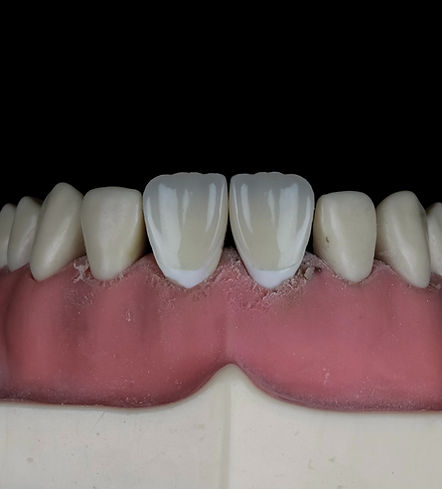
Composite resin veneers are made in 2 stages:
-
Initial consultation
-
Direct production of the veneers: the practitioner shapes the veneers directly on the teeth.
III. Tooth whitening:
Teeth whitening is performed using a gel that is applied directly to the teeth and is carried out in two ways: Chairside whitening (immediate) or Outpatient whitening (at home).
1. Chairside bleaching (immediate):
It is done in a single session at your dentist and you get immediate results.
2. Outpatient whitening (at home):

During the consultation, an impression of your teeth is taken to create custom-made trays, and you are given a whitening product that you apply every day for approximately 2 to 4 hours. The results appear after a few days.